

The V Word
Evolving From Victimhood to Freedom


When people are on a healing path, they often judge previous versions of themselves. They erroneously believe that what they discover through experience should have miraculously been known to them in the past. It is really hard not to do this. When you have changed, it can be very cringy to remember how you used to behave, think, or engage with life.
Reframing your understanding and thinking about healing can be extremely useful. Ultimately, healing occurs developmentally, moving through stages over time. Reflecting on the stages of child development can bring to light just how self-critical we can be. Would you ever shame a baby for not walking? You certainly wouldn’t look at a four-year-old and not understand why they cannot read and write. We intuitively understand that certain developmental processes take time. It begs the question, why do we judge ourselves when we are in the process of healing?
Much like physical healing, psychospiritual healing takes time. A cut in the skin doesn’t become a faint scar overnight. It must scab over, and specific vital cells in the body must assist as it transforms. Utilizing an antibiotic ointment and keeping the area clean facilitates the process. Similarly, we can’t simply undo the injury when emotionally hurt; we must go through a healing process.
In many cases, factors outside our control cause hurt or trauma, and we must tend to our inner wounds with care. Once healed, the scars become our history, and the lessons learned become our treasures. The robust process of healing has that much potential! It can take us on a path from victimization to freedom. Collectively, we are all moving from a sense of victimhood to self-agency. Our evolution is moving from one of surviving to an experience of thriving. Thriving will mean that we are operating with shared power, mutual interdependence, and personal autonomy. In essence, we are evolving out of victimhood, from a position of having power over one another to a place of cooperative power with one another. How do we make this tremendous leap?
First, it is essential to distinguish the difference between the energetic state of victimhood and the experience of being victimized. Things that are beyond our control happen to us, and sometimes, we are, in fact, the victims of circumstances such as other people’s behavior and outside forces. The deeper understanding of victimhood does not wash over these painful life experiences, but provides an opportunity to work through them and find agency and even growth from our traumas.
“Whether we know it or not, most of us react to life as victims. Whenever we refuse to take responsibility for ourselves, we are unconsciously choosing to react as victim. This inevitably creates feelings of anger, fear, guilt, or inadequacy and leaves us feeling betrayed or taken advantage of by others.”
- Lynne Forest
Stephen Karpman, a psychiatrist and teacher of Transactional Analysis, developed the “Drama Triangle,” a subtle dance of victimhood roles—the victim, the persecutor, and the rescuer. Essentially, we all develop a distinct identity in one of these roles, and once we act upon that identity, we ultimately experience victimhood.
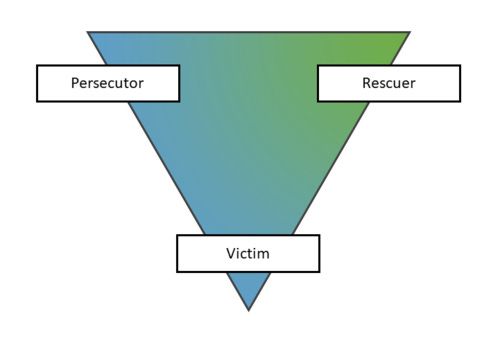
Lynne Forest, a teacher of transforming victim consciousness, utilizes the following clear and simple example:
“Dad comes home from work to find Mom and Junior engaged in battle. “Clean up your room or else,” Mom threatens. Dad immediately comes to the rescue. “Mom,” he might say, “give the boy a break. He’s been at school all day.”
Any one of several possibilities might follow. Perhaps Mom, feeling victimized by Dad, will turn her wrath on him. In that case, Dad is moved from Rescuer to Victim. They then might do a few quick trips around the triangle with Junior on the sidelines.
Or maybe Junior joins Dad in a persecutory “Let’s gang up on Mom” approach, or then again, maybe Junior will turn on Dad, rescuing Mom, with, “Mind your own business, Dad. I don’t need your help!” So it goes, with endless variation, but nonetheless, pinging from corner to corner on the triangle. For many families, it’s the only way they know to interact.”
These dynamics appear in our relationships with ourselves, others, and our world. Healing our victimhood means that on a personal level, we are learning to step away from all forms of subjugation. But first, we must recognize that when we embody these roles, it can be very subtle.
Reflecting on victimhood patterns in my own life, I recognize that I have significantly grown and changed since my younger years. In young adulthood, I viewed myself as responsible for many people around me, constantly attempting to control and rescue them to make myself feel safe. Through time and healing, I rarely feel that same pull. And yet, recently, motherhood uncovered new ways in which I was rescuing and persecuting. Each time I tried to control or change my children, especially in their teens and young adulthood, I stepped into this drama triangle, often frustrated. The frustration of being unable to control another person is a clear sign of victimhood. Controlling my children looked innocent enough, but at its core, it was judgment and rescuing masquerading as “good parenting.” It is no surprise that parenting brings out our unhealed victimhood.
Working with clients, I have discovered that you can not rush another person out of this dynamic. In fact, much of our healing resides in this dynamic. For example, when someone has been abused in some way, there is an essential part of their healing that cannot be dismissed. They may need to learn how to work with their emotions by ragefully blaming their abuser during their recovery. They may also need to set firm boundaries to feel safe. To imagine skipping over these important emotions and skills feels both impossible and potentially harmful. This is the very reason why I now consider the process a developmental one. Each person must move through various layers of healing before they are able to recognize and then let go of certain aspects of victimhood. And, like all healing, it is not a linear process.
Quite often, clients need to experience themselves as victims of their parents’ unhealed ways in order to access the deep love and compassion toward themself in their stored hurt. It wouldn’t be acceptable or advisable to hurry them through the process. Eventually, however, when there is adequate attention and care toward their woundedness, they can see their parents more clearly. They can see their flaws, pain, and even poor behavior, but they no longer feel victim to it. Instead, they begin to have compassion toward their parents. I’ve witnessed this occur even when the adult child is no longer in contact with a parent because of the amount and gravity of the harm caused.
We must accept that evolving out of a place of victimhood requires time, experience, and growth. Having grace for ourselves and others when these dynamics are at play is not only the kind thing to do but also the only way to deal in reality. Much like the tenderness you feel toward a baby who cannot yet walk, you can gently view yourself moving at your own pace to figure out how to evolve into greater freedom. The key to evolving and healing resides in simultaneously deepening your awareness of your victimhood roles, changing how you respond, and being patient with yourself in the process. Like all healing, it is not about perfection, but about creating greater well-being in your relationships and your life.
Great piece about healing and growth. Makes me think about our scars and the beauty that is found in them.
Love this, Jenny! So beautiful! I wrote about tenderness this week. Writing has allowed me to experience tenderness for myself in a way I did not know before.